

hate is stupid
the world is full of love…
you just need to know where to look
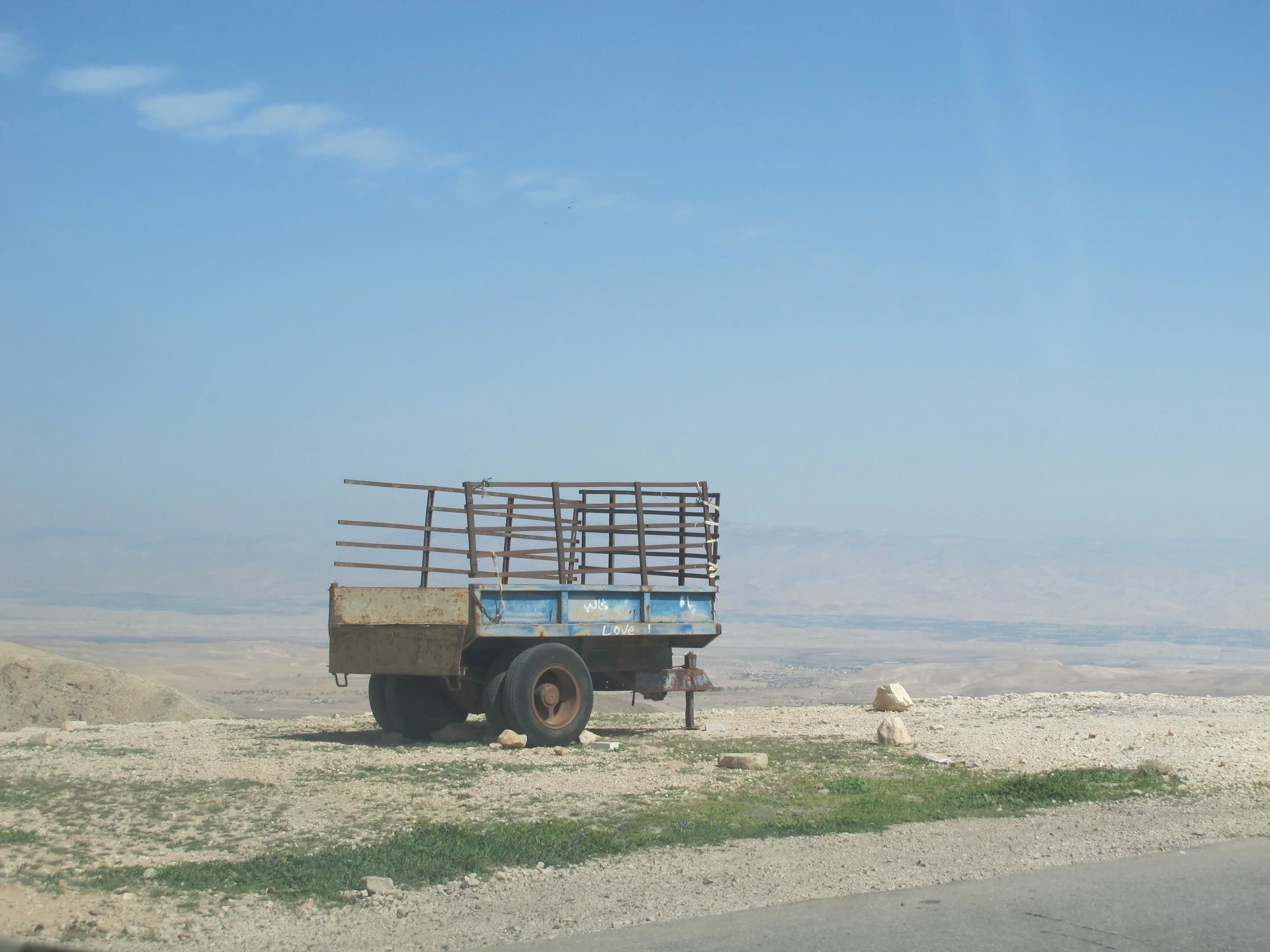
View from the West Bank, Palestine of the Dead Sea area near Jerico
The Anti-Travelogue of Trial & Transculturation
This is an anti-travelogue. Where so many travel writers treat the world as a buffet of images and sights to be consumed, and where the local people in their homelands are merely props for influencers to put themselves front and center, this is about a writer who immerses himself in the soils of the lands he visits and engages in meaningful relationships with the people he meets.
Starting at 25 years old, I budget traveled the world, totaling 10 years outside the U.S. across 30 countries. I volunteered on organic farms, worked field labor, ran a hostel, hiked hundreds of miles and taught English in the Himalayas. I wrote the whole time, and share those former experiences in this travelogue. Today, I continue to write engaging adventure stories applying these high-impact experiences of my life to social issues including race, identity, the idea of belonging and the ideal of utopia.
While many things went wrong on my crazy journeys, you will see through my eyes a shifting view of the world that reflects a transforming person who’s willing to make mistakes and cares to make things right.
Once travelers—and regular people, too—can all stand back and shut our mouths, listen and learn like I finally did, we can begin the process of changing ourselves instead of changing the world to meet our whims. Only then can we begin the process of together creating a lovely planet.
The world isn’t what it seems…
some people are cool.
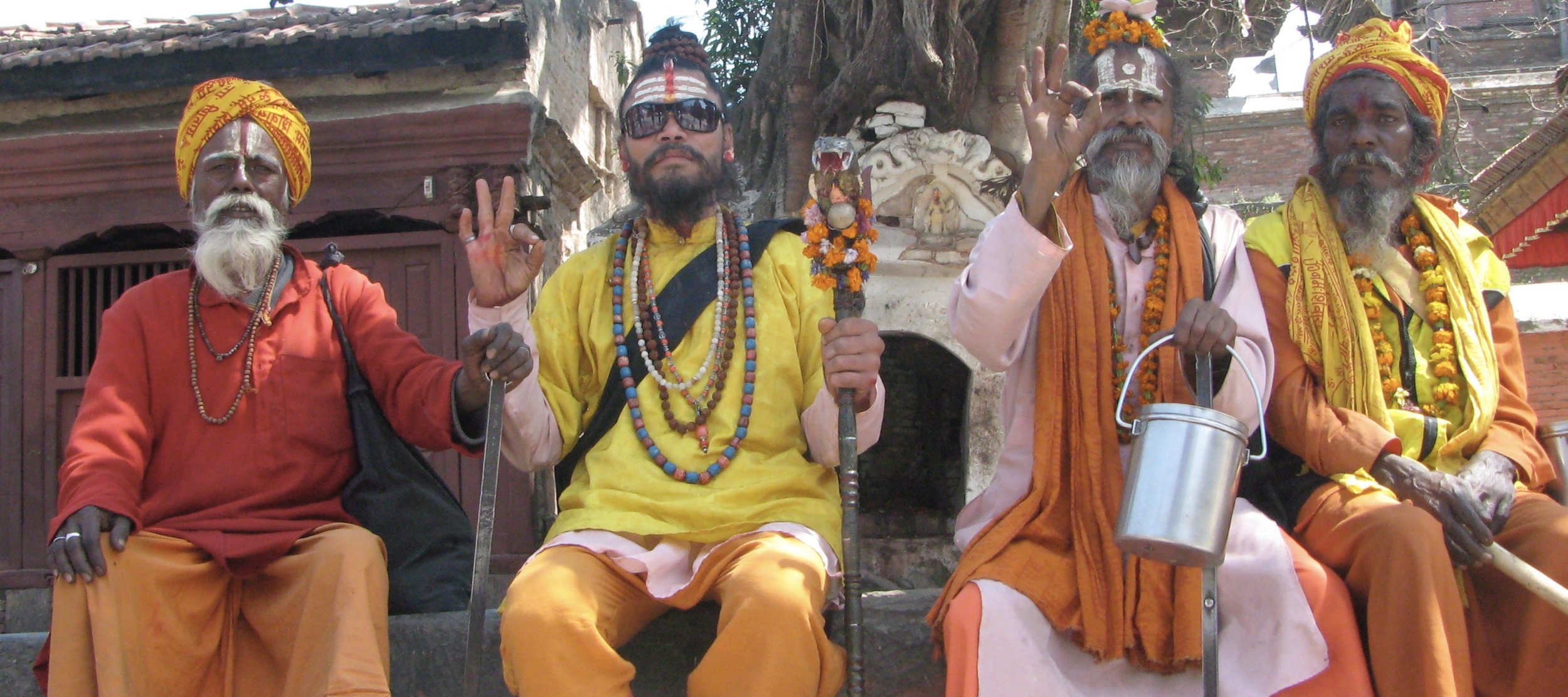
Holy men collecting donations in Kathmandu, Nepal
The Flight Home: Coffee Slick & Noitu Love
The aromatic stench of airplane coffee and illumination of the cabin lights, it all feels so Tuesday morning. Sure, it is Tuesday morning. But still.
Tuesday, really, is behind us. Ahead of Melody and I, beyond the international date line and across the Pacific Ocean, is another Monday. We are going to have two Mondays in a row. And what a day of the week to double. As such is the glorious whiplash of intercontinental, cross-hemisphere, crick-in-the-neck, twelve hours aloft air travel.
‘Oh, wow,’ I gawk at the view through the aircraft porthole.
Mooshing my greasy forehead up against the plastic window, my unblinking stare faces California.
Just along the bottom edge of the plane’s wing in the blackness of the night sky, I glimpse a slice of Monday coming back around to finish its weekly scourge of the planet far below. This glimpse of light, the light of my future and somehow also my past, is a knife edge defining a horizon amidst the blurry blending of sky and ocean. That distant strip of sky is the thin line of text on a blank screen growing into a thing beyond its individual units, more stratospheric, atmospheric, astronomical than its individual units. And I am the cursor of the narrowest panorama I’ve ever seen.
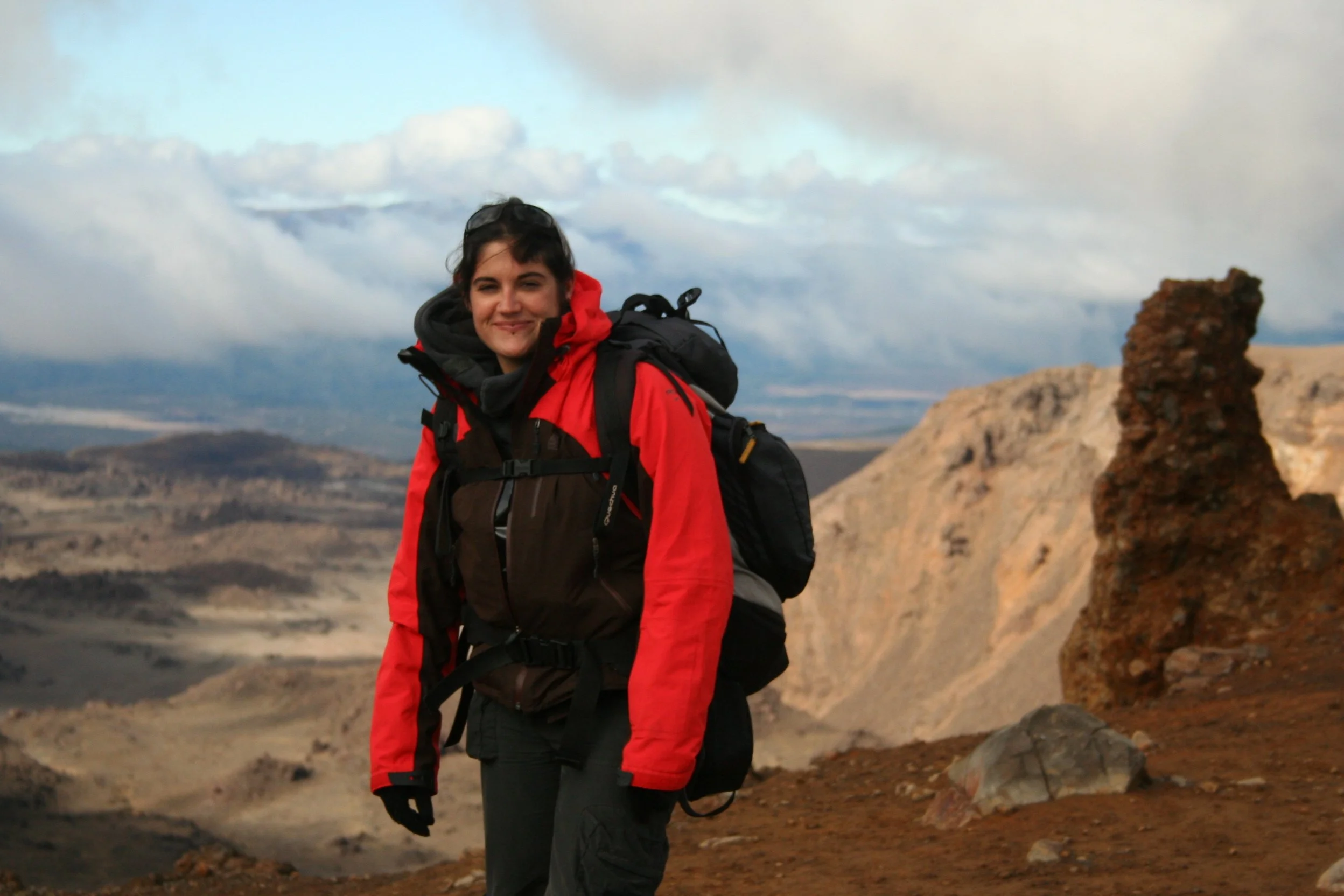
Melody at the summit of Tongariro Crossing, New Zealand
As always, of course, I am typing on my fold-out pocket keyboard. And as the words bleed onto the digital page in a delayed stream, expanding into a thing richer and more alive than a single line, so does the sky.
Daylight spreads beyond the wing, and thanks to the joyous perk of air travel called turbulence, my coffee coats the fold-down table. Oh, joy, the coffee slicks my travel tray so completely its smooth surface and the bottom of the compact keyboard hug one another in a desperate plastic embrace. It’s a beautiful marriage of petroleum products on their forever journey from underground to above the clouds to floating in the middle of the ocean. It’s beautiful. Everything in this cramped corner of the vastest expanse of oceany nothingness on Earth just seems so beautiful.
Look! The sky, now, is the same forge red of that morning on top of the Taurangas we just happened to wake up to witness, watching in silence before spooning back up to sleep.
“Even if I could fly around the world in a day, I’ve seen enough to know it is not a small world. I could travel my whole life and barely graze the surface of all humanity is and has done and can be.”
The world dawning on us, we have left New Zealand for America. And after Melody’s limit of ninety days in my home country, and mine in her native France, we are off to India. Because India is the one place in the world we both have to go before we die, the one place in the world where only real backpackers go. And we—grimy, feral, broke-ass we—are real backpackers.
The world, still, is a place of infinite possibility to us.
Even if I could fly around the world in a day, I’ve seen enough to know it is not a small world. I know I could travel my whole life and barely graze the surface of all humanity is and has done and can be.
In less than a year from now, we will be hiking the Himalayas up to almost twenty thousand feet. We will look at Mt. Everest’s summit in the light of dawn from Kala Patthar. Everest, with the sun shooting rays of light from all around it, will be more right there than far above.
At the top of the world, we’ll look down upon Earth from the elevation of an airplane. But we will have walked to this height the whole while breathing the uncanned oxygen of the cold thin air of so many gorgeous melting glaciers. We’ll get to the top of the world one step at a time, carrying our bags alongside the Sherpa people porting cases of beer and candy bars for people less conscientious than us. From the top of the world, we will be reoriented back toward civilization with a new calm in our hearts.
For now, we hang in the liminal space above the planet’s largest ocean, the night sky seeming a daytime blue. Yet there are stars up there too, a whole lot of them. The view floods into me. My entire field of vision is sky, only sky, turning into hues of salmon. Hark! A deep rouge suddenly takes over the soft fleshy orangeness. And I begin to realize the sunrise must be accelerated as we rocket five hundred miles per hour eastward, crossing the equator to the northern hemisphere, the half of the planet where I’d spent my entire life until less than a year ago.
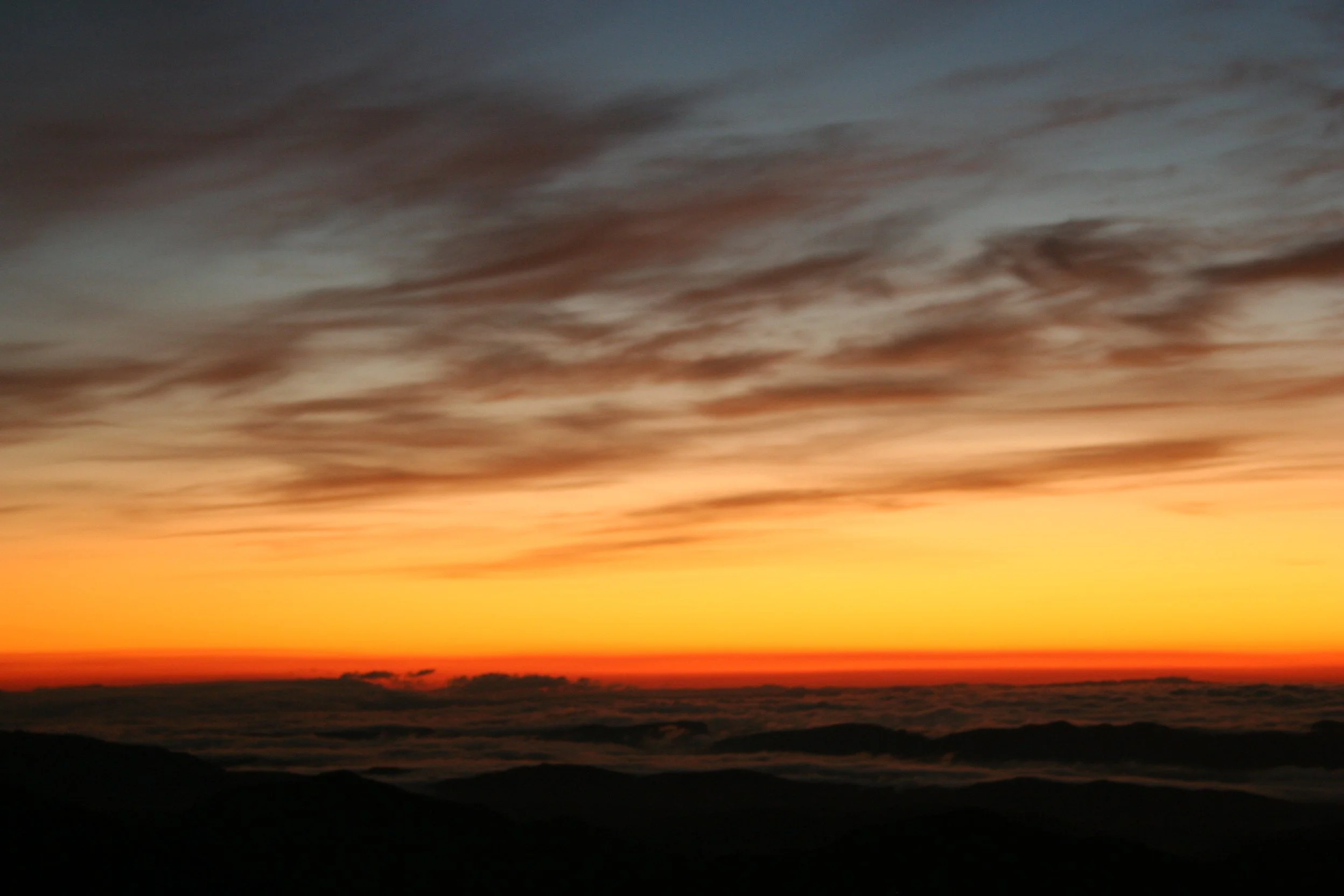
A salmon sunrise glimpsed from an aircraft porthole
I think about that near-year in New Zealand.
All the field labor and the laughter, all the wet treks and the lovemaking, that last foetid hostel stay in Auckland, how the manager was up until all-hours in that room beside the kitchen with a ratty blanket draped over his mohawked head and a spliff cupped in his hand, fire illuminating his hand and face, his eyes staring at me like an animal, a creature, a demon of sleep.
Fire now. The sky is fire.
And this sunrise makes me think of revolution.
Just writing the word revolution I realize, gobsmacked, the first five letters reversed spell lover. I try to make noitu lover mean something. And even when I know it never will, it serves as a perfect metaphor for life as a traveler. As you revolve around the world, you expect everything to revolutionize you.
You need the sunrise to mean something. You believe the coffee slick is a sign. Your back pain is proof of a life well lived. A grimy street corner is art, will always be art immortalized in a whopping 6.4 megapixels on your precious memory card. And none of it feels cynical.
You never feel stupid, clutching the souvenir. Not as long as you still breathe free of the dreadful suffocation of the bubble called your life, not as long as you can delay the ultimate immolation of your hopes, not as long as the internment of the ashes of your youth and dreams and your goddamn noitu love is delayed in transit.
“What self once was, now no more than a flimsy frame of film, an existential blip, a mere notch in the fleeting present tense.”
Wow, I think as I clutch Melody’s hand, why can’t I just feel this way all the time? Maybe it’s just the coffee. Probably it’s just the coffee.
And though it is really hard to fathom that I am sitting there with this French girl curled up against me squeezing my hand, I know it is real. The dampness of hot coffee growing cold on my thighs and the crick in my neck tell me this beautiful moment is real.
Everything is supposed to go back to normal, even without sleep. Terrestrial concerns like time, the correct sequence of the days of the week, planting our battered hiking boots back on terra firma, should resume their regular programming shortly. Our minds and spirits will eventually catch up with us, naked in the harsh light of quotidian reality.
To be gauche and lapse philosophical, I’d say this:
Real life isn’t a movie, but it is cinematic. We only exist by the succession of almost completely identical moments occurring at thirty frames per second. Every thirtieth of a second, we are one thing, one person, one thought. Then that thing is all gone, replaced by an almost identical one. We survive as a continuous entity only based on the knowledge that, when we open our eyes after a blink, a recess from conscious awareness, things will be discernably the same.
I look out the window to realize the waves down there are not waves, they are clouds. Because after hours of watching the waves knowing they are waves, I suddenly see a break in them. It means they are clouds and the ocean must be far beneath. This functions as the reminder of the premise we only understand change by proxy of comparison, seeing things in the proverbial light of day. What self once was, now no more than a flimsy frame of film, an existential blip, a mere notch in the fleeting present tense. And when our grasp of self gets too far ahead, or slacks off for an afternoon, there are countermeasures to compensate, like the drag of boredom or anxiety, or leaps of hopes and dreams.
Does this make any sense? I’ve been up for a long time, so long it is beyond time, two times at the same time. Does it really matter what time it is here? Is there even a here, here? Can’t it be both, can’t we have duty-free time once in a while? The little padded TV above the aisle says Kalapana is 822 miles away. What’s Kalapana? What does the air smell like there? Do they have tree ferns, or coconut trees, or campers spooning amongst the tendrils of morning mist?
Still, entertain this question. When you think about what you will do today when today is a day you’ve already lived, would you change anything about it? Am I not a creature shedding the human flesh that embodied yesterday, sprouting some new today, having been born under cover of night, under cover of a lapsing consciousness? What more can we be, in this moment, in a future of infinite moments containing an infinite us?
I had something to say about being prepared to experience the same exact moment for eternity, the moment where you know what is cloud and what is water, what is she and what is you. But it’s all mixed together.
I now see the fleece of the white stuff shrouding the ocean with cowlicks and striking shadows, the glower where a star seems to blink off, patient, there but not there… like all of us. And I know this magic of time, and the devastation of it. How a great part of my life is already over. A great part of our life is already over. We have shared a time together that has already ended. And we are only twenty-six.
I had something to say about being prepared to experience the same exact moment for eternity, of being in that place the sky is orange sherbet forever. But now all I can feel is this sinking feeling that I’ve become unmoored. Returning home to the place from which my passport was issued means I’m not a foreigner anymore. I’m not really a backpacker anymore.
My entire identity has suddenly been lost here above the clouds. All I can do is regress, and feel determined to start over. I have to. I have to leave again, in ninety days, because I am in noitu love with a foreigner.
A sublime blur now creeps across the globe at the speed of daylight, plus five hundred miles per hour. A baby blue glow sprouting and sprawling a thousand miles south of Honolulu, bringing the promise that when I return to the baking sunlight of California, I will know how to transcend the day, even when it is my second Monday this week.
Before Disembarking, Let’s Get Lost in a Strip Mall
It’s one of those dog days of summer, much like the day I was born.
Impossibly warm and sun-soaked for this late in the day, Harvard Square writhes with the hush of old-city beauty. Three-story brick apartment buildings abut Harvard University near the Charles River in a network of narrow one-ways. Oh, these brick-paved sidewalks and quaint brick alleyways, they make young-American-aspiring-world-traveler me feel so wonderfully foreign. Like I’m a European in my own land.
Melody, of course, is a foreigner and European for real, that lucky duck. As she senses with her dark French eyes my attempt to make her feel at home, she has to let her ambivalence show. Melody simultaneously loves America and wants to leave. Once we continue on to France, she will have finally encircled the globe after seven years ‘on the road’, as she calls it. I can only dream of such a thing, not sensing I will do it many times over in the years to come.
On this day in Cambridge, I am twenty-six, and I hold Melody’s hand like the boy I am, tugging her along brick pathways, cutting through alleyways willy nilly, swinging around the light poles and tree trunks that force us momentarily apart. And for me being here in Boston brings a double-edged sensation, a childhood memory of a pleasant past, a psychedelic dream of an unforeseeable future. I am enchanted yet disenchanted. For I will always be more foreign to this place, my home, than the world at large.
How we came to be here, together, is not an uncommon story. Two young travelers meet on the other side of the world and bring one another home, one after another, for family and fresh tourist visas and, well let’s face it, for money... We get free places to stay and paint boats and houses and make a stone terrace in a day. And we do it all only to continue on around the world once again. But we are done working on this day, this doggone dog day of summer, to take the opportunity for Melody to see the America in which she has been illegally laboring. And all I get for my efforts is lethargy and weak laughter.
I pick up an old bottle cap and offer it to her. It is really a nice bottle cap.
‘Ew!’ She recoils from my gift on the brick sidewalk, ‘You always give me things that you just pick up somewhere.’ She drops my hand and pulls ahead.
I chase her and catch her stride, ‘Yeah but, no but, yeah I know,’ I joke, getting her to smile again with my cheeky antics. Our lives aren’t really that hard, all those ten-hour work days are in the name of travel, in the name of sitting on some beach somewhere under a palm tree and just swinging in the breeze…
‘Remember, babe,’ I say, ‘we gotta be thrifty. One day of work here will get us through a week in India. Two weeks, if we are thrifty there, too.’
She does not accept the bottle cap, so I pocket it, sure the right time will come.
For now, I’ll tell you how I left home to Asia for the first time in my life by starting at the beginning.
Starting at the beginning…
It was one of those dog days of summer, much like the day I was born.
‘Hi! I was wondering if you could give me some of your rates?’
‘Yeah, sure,’ the receptionist at the doctor’s office says, ‘what is it that you want?’
‘Hmm, let’s see,’ I unfold the sheet of paper covered with phone numbers and scribbled bits of directions and find the list I have compiled, propping a paint-splattered foot on the windowsill of the open car door while gazing out at the crisp, brown lawn from beneath the canopy of the crabapple tree at my uncle’s new house. ‘Oh, here it is. Okay, how much for hepatitis?’
She says in an unenthused way, probably in some air-conditioned office in scorching downtown Boston on the hazy horizon towards which I gaze, ‘Hep A or B?’
‘Umm, I’d like to start with Hepatitis A.’
‘That’s sixty-five dollars.’
‘Okay. And typhoid? Polio?’
She clacks away on her keyboard, ‘Do you also want tetanus and diphtheria?’
‘I don’t know, maybe?’ My words come out uncertain, ‘I’m going to India, so, uh, probably?’
‘Great, I’ll put you in for a tetanus and a diphtheria’
‘And I need pills for Malaria, too. I think I want to talk about rabies and yellow fever with the doctor. You know, before I splurge on diseases I don’t need.’
When I find the office hidden in the back of a little Cape Cod shopping plaza, the cold AC air spills out onto the sidewalk even before I enter through the door from the heavy, sticky and oppressive morning air. There are several waiting rooms and I chat with waiters who are already dissatisfied, pre-pissed off if you will, even before they’ve met with any doctors. In one area, a long hallway dead ends where two people are sitting outside a closed door.
‘Hi, is this where I wait?’ I ask them, looking around, seeing no more than their two chairs.
‘They told us to sit here and someone would come out that door,’ a sour old man says, incredulously looking at his surroundings: cheap purple carpet, hospital white walls, one of those mass-produced plastic-framed paintings of a boat. There isn’t even a table with some nurses’ old magazines with the mailing label cut out for his entertainment.
I turn around and find another room. There are a bunch of old people in there, too. Before I can approach the nurses’ door that sits ajar, a lady yells, ‘Hey, you have to sign in and wait!’
‘Oh, hi,’ I shrug, inching towards the doorway and seeing two conspiring nurses through the crack, ‘I just want to make sure this is the right office.’
‘Are you here to give blood. They’re taking our blood!’
I look at the crumbling, blue old lady before putting my face to the crack in the door, yelling, ‘Is this the office for vaccines?’
A nurse yells back through the crack, inches away, ‘Across the hall!’
When I open the door on a waiting room across the hall, it’s even colder. CNN is delivering propaganda from a TV in the ceiling and a single girl in a pink tank top, jean skirt and Birkenstocks has her crossed legs wound around one another two or three times, rubbing them back and forth and breathing into her white-knuckled hands.
This isn’t the office, either, but with permission from a pasty receptionist, I am allowed to tip-toe through the network of superficial partitions and paperwork, capering my way down a hallway to arrive at a high counter decorated with a skeleton dressed as a Red Sox fan where there is a woman at a desk somewhere far below. Anyone smaller than me (which is everyone) would never have found her.
This time I say with confidence, ‘I’m here for the eight forty-five!’
‘Oh yes!’ She pokes at her computer, then pulls out a clipboard and a couple sheets of paperwork, handing them to me, ‘And what insurance do you have, are they covering you for this?’
‘I am certain,’ I announce, ‘they are not.’
I walk away. When I sit in a small walk-in freezer of a waiting room with last years’ Time magazines strewn across a low table, hearing the receptionist on the phone explaining the really very simple directions for finding the office to another gullible victim, I feel relatively comfortable. This is all supposed to be a positive thing, these diseases, the vaccines for them, I mean. A trip to India, Nepal, and possibly the Middle East or Southeast Asia has its price, if I want to live to tell the tale.
A medium, shapeless woman whom I presume is a nurse fetches me and sits me down in a room with a bed made up with paper sheets, a plastic chair, and graphic pictures on the walls. I have ample time to take in the horror show of shingles, mumps, chickenpox, smallpox, malaria, dengue and yellow fevers, and their corresponding geographical charts indicating that I am going where most of the diseases (and some that I thought extinct, like leprosy) exist.
The nurse returns, sits down beside me and reads what I wrote: England, France, Italy, India, Pakistan, Nepal, Tibet.
She looks at me, tan and fit with buzzed hair, in a t-shirt I came up with that says: Live Gently, Intelligently.
‘Six months. You must be in the military. Navy? Are you an airman?’
‘Not quite, no.’ I smile at her, ‘I work on boats in the summer and travel every year. My girlfriend’s French, so we’ll be living in France, before India.’
‘Oh.’ She looks at me as any small-town American would observe any foreign object, ‘And where are you from?’
‘Here!’ I laugh, ‘I was born in Boston.’
‘Oh, it’s just that you have such a thick English accent anyway.’
I blush. Not for me, for her.
‘He’ll be in in a minute,’ she stands up, the purpose of her visit presumably serving the American tradition of making it seem as though the strip mall medical establishment is providing a service I could not administer on my own. Stick it in your arm, push the plunger.
She opens the door and turns to me, ‘Oh, you’ll love Italy!’
The doctor arrives, eventually. We go over the diseases she should give me today and I decide to take all five and she hands me a stack of internet updates on all these epidemic and endemic diseases. And this is the stage where I realize I’m going into another world, not as a local, but someone culturally, racially and immunologically separated. We—Melody and I, but also all Westerners—aren’t supposed to drink what the Indian people drink or eat the food the Indian people eat. But we are, paradoxically, going for the express purpose of doing those things.
I feel a rumbling in my stomach, perhaps from the watery sludge Americans like to overheat then call coffee, but more likely from the realization that this visit makes it all real. I am administering costly and painful treatment to my body so I can deliberately make my life more challenging and dangerous than it would be if I just stayed right here.
The nurse comes back in with a handful of hypodermic needles wrapped in a paper towel. She sits me down on the rustling white paper of the black pleather bed and rolls up the sleeves of my t-shirt.
‘Oh!’ She says this to herself as she sees my left shoulder, ‘It looks like I’ve got a bulls-eye here,’ she wipes the red star tattoo with alcohol, then starts stabbing away.
I sit there learning about smallpox and recalling my doctor’s visit this time last year where I got tested for HIV, gonorrhea, syphilis, chlamydia, herpes, hepatitis and the lot, ‘the gamut’ the doctor had joked. It’s the third time in a year I can feel the needles break the surface of my skin and slide into the flesh one after another.
I look to the opposite wall when she switches sides to do the other arm.
‘Well,’ she says, tossing the last needle in a biohazard bin on the wall, ‘you have certainly been one of the best patients I’ve had. You’re so relaxed.’
‘I used to watch them taking the blood when I was a kid, but I can’t watch anymore,’ I tell her, feeling the frigid pharmaceutical serums spreading one after the next through my bloodstream like a showering of cold water on a humid day.
‘I guess we all grow up,’ she says.
My body will build up antibodies to fight these diseases. But it won’t immunize me from the horrors humanity faces, horrors I’m prepared to face, even if it will fundamentally change my life.
‘You know the way out,’ the nurse says with hope in her eyes.
‘I know the way out,’ I smirk. Because remembering where I came from, well, that’s the only way to keep from getting lost.